
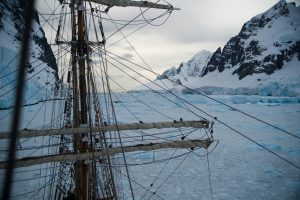
Photo by Torsten Dederichs on Unsplash
Everything is changing in the world today, but business is still driven by the same philosophy: identify a problem customers have and deliver a solution. But what happens when your plans to solve for X get suddenly and unexpectedly disrupted? Well, for a business to survive, you need leadership to get through hard times, and a team filled with grit, patience, and discipline. One example of such a crew who faced the impossible and made it happen was the crew of the boat Endurance.
Endurance
“For scientific leadership give me Scott; for swift and efficient travel, Amundsen; but when you are in a hopeless situation, when there seems no way out, get down on your knees and pray for Shackleton.”
Sir Ernest Shackleton set out in 1914 with a crew of 27 men to cross the Antarctic continent on land from coast to coast. Almost every conceivable calamity that could occur did occur. Their ship was crushed under the force of an encroaching ice pack. They were set adrift on ice floes, their supplies dwindling, with no help or rescue from outside sources. In the midst of harsh conditions and with such a bleak outlook, Shackleton led a group of five men in a lifeboat on an 850-mile journey across the notoriously brutal Drake Passage to a whaling station, where he was able to find a ship to help him return and rescue every single member of his crew.
He could have sent others to find help. He could have given up. But instead, he led when there was almost no precedent suggesting success was possible.
The Importance of Leadership
“Fortitudine vincimus — By endurance we conquer.”
When the plan goes wrong, effective leadership is the only way to regain momentum. Part of accepting the role of a leader is accepting the responsibility of what has occurred. Not to lay blame, but to exhibit that you are going to lead the team out of the hardship. Shackleton could not control the ice, the weather, or the destruction of their ship. However, he could control his response to those challenges and set the appropriate tone for those who were there with him.
Today’s economies are faced with global war, tariff and trading wars, and a lightning-fast change of conditions that may affect your business. You can fret and worry over those encroachments into your own business, or you can take charge and focus on what you can control. Leadership will provide direction, and with that direction, a shared mission to keep the team engaged. With your own example, you can excite those who work for you and get them to take on challenges that may have been beyond their desired scope of influence when times were good. All hands will be needed on deck, and that means empowering your team through your own actions.
Keeping Up Spirits
“Of all their enemies — the cold, the ice, the sea — he feared none more than demoralization.”
Shackleton knew that when people give up, no amount of resources can overcome hardship. You must recognize this fact as well. While your business may not find itself marooned on a frigid land that leaves little to no hope of rescue, exhaustion can take the form of both mental and physical deficits. Leaders must establish the organization’s emotional climate.
Your team will take its cues from you. If they see you in emergency mode every day, they will respond in kind. While some people may respond at their best when under pressure, others will crumble. Your job as a leader is to make sure that the team is in a position to solve problems and not to suffer from worrying about them. That may be as expansive as giving an inspiring pep talk, or as simple as assigning tasks that reinforce their purpose and give them a sense of playing a part in the rescue. Additionally, they need to see you steady in times of turbulence. If you flinch, and they see you, then your crew will start looking for the lifeboats.
Plans Will Fail. Deal With It.
“For scientific leadership give me Scott; for swift and efficient travel, Amundsen; but when you are in a hopeless situation, when there seems no way out, get down on your knees and pray for Shackleton.”
The challenge started out as an expedition to make history. Once his ship foundered, all bets were off. A new goal had to be identified, and then a plan formulated. That goal was to survive and save all of the 28 men on the journey. There could be no what-ifs. The old plan had to be abandoned so that all men could focus on the new tasks.
When your business faces hardships, you will have to do the same. Entrepreneurs need the same willingness to recognize a changed reality and adapt accordingly. You cannot split your attention in the hope that things might turn around and the original plan can be salvaged. Drops in revenue, customer losses, and project failures are likely to make people panic, especially if their leader is affected equally. Your ability to move on and set in on addressing the new challenges, identifying the new direction, and delivering the new actions is what will keep people calm. Calm people are adaptable people, and better able to weather storms and hard times.
Sometimes, success means surviving long enough to get back on track. In business, success more often means surviving long enough to create a new opportunity. Shackleton never completed his planned expedition to cross Antarctica. What he did achieve, however, was to exhibit the finest leadership qualities in a situation where the lives of 28 men were at stake.
For entrepreneurs, the lesson is that you cannot control when things go wrong. You can only control how you react, and how those reactions affect your team. To get through the storm of business upheaval, it will take all hands rowing in the same direction. And that will take a leader they’ll want to follow.
If you are ready to purchase and lead a new business, give us a call. To see other books we have covered in this series, click here.